Quarterly
Market Update Q2 2026
Read More


Quarterly
The 2026 harvest arrived early and short. Burgundy began picking earlier than at any point in some five centuries of records, Bordeaux recorded temperatures of 44°C and lost around 42,000 hectares to wildfires (smoke taint is not currently expected), and frost followed by heat cut volumes in Champagne. As we anticipated in our last update, this makes a third consecutive short vintage for several of the regions we invest in. The supply of top wines continues to contract at the source, just as demand returns.
Against this backdrop, Q3 2026 extended the recovery – at a calmer pace than the exceptional second quarter, as is usual over the summer, but with broader participation. Realised trade prices rose a further 1.5%, the fifth consecutive quarterly gain and the highest level since Q3 2023, and more than half of investment-grade wines traded higher. Every major region ended the quarter up on a twelve-month view.
The summer pause we flagged in Q2 showed up in prices, not in activity. Trade value rose roughly 25% against the second quarter and 18% against Q3 2025, with July marking a fifteen-month high. More telling is who is driving it:
American buyers accounted for 35% of trade in August, the highest share since January 2025, and for more than half of all Champagne trade in the final weeks of September. Clarity on tariffs and a larger US Champagne quota explain much of the move. We welcome the depth this adds, but our view from Q2 stands: it is a flow that has proven sensitive to policy before, and not one on which we would build a thesis.
In Q2 we expected exchange prices to converge toward auction levels. In Q3 the opposite happened: auction prices rose 1.9% in the quarter and 8.9% over twelve months, against 0.6% and 2.5% on the exchange – a record gap of 13.6 points. Collectors at auction continue to pay up for scarce, mature bottles, while exchange benchmarks move more slowly. As our portfolio is valued at Liv-ex exchange prices, the distance between our marks and where wines actually change hands has grown. Convergence has been delayed, not cancelled.
Measured on the same Liv-ex price basis as the market indices, the Fund I portfolio rose 1.3% in Q3 and 4.1% over the past twelve months – in line with the Liv-ex Fine Wine 100 (+4.4%) and well ahead of the broader Fine Wine 1000 (+2.0%). This like-for-like figure excludes the discounts at which we buy, which come on top: since inception the fund stands at a gross TVPI of 1.17x.
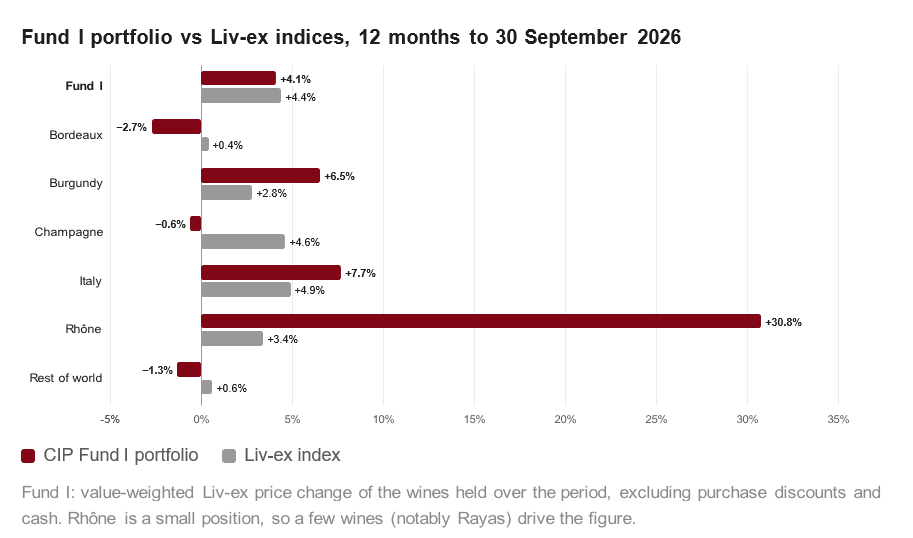
Burgundy (+6.5% vs + 2.8% for the Burgundy 150) and Italy (+7.7% vs +4.9%) led, reflecting our concentration on top domaines and benchmark Tuscans. Bordeaux was the weak spot (−2.7% vs +0.4%): our Bordeaux is weighted to young vintages, the segment the market currently favours least. Champagne trailed on a twelve-month view (−0.6% vs +4.6%) but turned decisively in Q3 (+3.2%), as demand returned to the prestige cuvées we hold.
The Burgundy 150 gained 2.8% over twelve months, with demand concentrated on a handful of top domaines – the top five producers took around half of all Burgundy trade value. This selectivity works in our favour: Leflaive Puligny-Montrachet 2018 rose 24% in the quarter and Arnoux-Lachaux Clos de Vougeot 2021 39%.
The Italy 100 was the best-performing Liv-ex regional index, up 4.9% over twelve months, with Tuscany leading year-to-date. Monfortino stood out in the wider market, with the 2005 up a quarter this year – supportive for our Monfortino 2019, now among our five largest positions.
Champagne remains the most concentrated market of all: the top five producers accounted for 72% of trade value and pre-2011 vintages for 77%. That is precisely where we are positioned. Selosse Millésime 2009 rose 49% in the quarter and Cristal Rosé 2014 23%.
The Rhône 100 rose 3.4% over twelve months, led by the Reynaud family estates. Our Rayas 2010 gained 43% in Q3. This quarter we added Guigal's three single-vineyard Côte-Rôties, completing a Northern Rhône exposure built on extreme scarcity.
Bordeaux was flat at the index level (+0.4% over twelve months), with young vintages weakest (2023 down 3.9%) and mature first growths firming. Some benchmark wines trade near multi-year lows – Lafite 2000 trades at its cheapest level in eighteen years. We used this window to add Cheval Blanc 2023 and 2024 and Mouton Rothschild 2019 at or below market.
Q3 2026 showed that the recovery can hold through the quiet summer months. Activity rose, buyers took the initiative and every major region is positive over twelve months. The independent sources we follow now agree that the market has passed its low and is in the early stages of recovery– but also that it remains selective, led by scarce wines from the very top producers.
We expect that pattern to continue into Q4, traditionally the most active period for auctions and year-end buying, with the recovery gradually spreading beyond the trophy wines. Our approach is unchanged: selective acquisition below market, broad diversification across regions and maturities, and the patience to let scarcity do its work.